
In this article
- What Is an AI-Powered CRM?
- AI Features That Genuinely Help a Small Business
- AI Features That Are Mostly Hype for Local Businesses
- The Rules Any Customer-Facing AI Must Follow
- What a Day Looks Like With an AI-Powered CRM
- Your Data and AI
- How AI Works in Bluu
- A Checklist for Choosing an AI-Powered CRM
- Frequently Asked Questions
- The Bottom Line
Every software company now says its product is "powered by AI". For a small business choosing a CRM, that makes it harder, not easier, to see what will actually help. AI-powered CRM software can genuinely save hours every week, answer customers you would otherwise miss and fill in records nobody has time to type. It can also mean a chatbot bolted onto the side of a contact list.
We build Bluu, the AI-powered CRM and marketing dashboard our clients run their business from, so we have strong opinions about which AI features earn their place. This guide separates the useful from the hype, explains the rules any AI that talks to your customers must follow, and gives you a checklist for choosing.
Key takeaways
- The most valuable AI in a small business CRM answers customers instantly and captures their details, so no lead goes unanswered.
- AI that fills in your records from your website, writes drafts and answers your team's questions saves real time every week.
- Predictive scoring and forecasting are mostly built for large sales teams with years of data, not local businesses.
- Any AI that talks to your customers must never invent prices or give professional advice, and must hand over to a person when unsure.
What Is an AI-Powered CRM?
A CRM, or customer relationship management system, is where every customer, conversation and follow up lives. If you are new to the idea, our plain English guide to small business CRM covers the basics.
An AI-powered CRM adds artificial intelligence to that foundation to do work a person would otherwise do: answer enquiries, capture details, write messages, summarize what happened and help your team find answers. The question is not whether a CRM has AI, it is whether the AI does jobs that matter to your business.
AI Features That Genuinely Help a Small Business
Answering Leads Instantly, at Any Hour
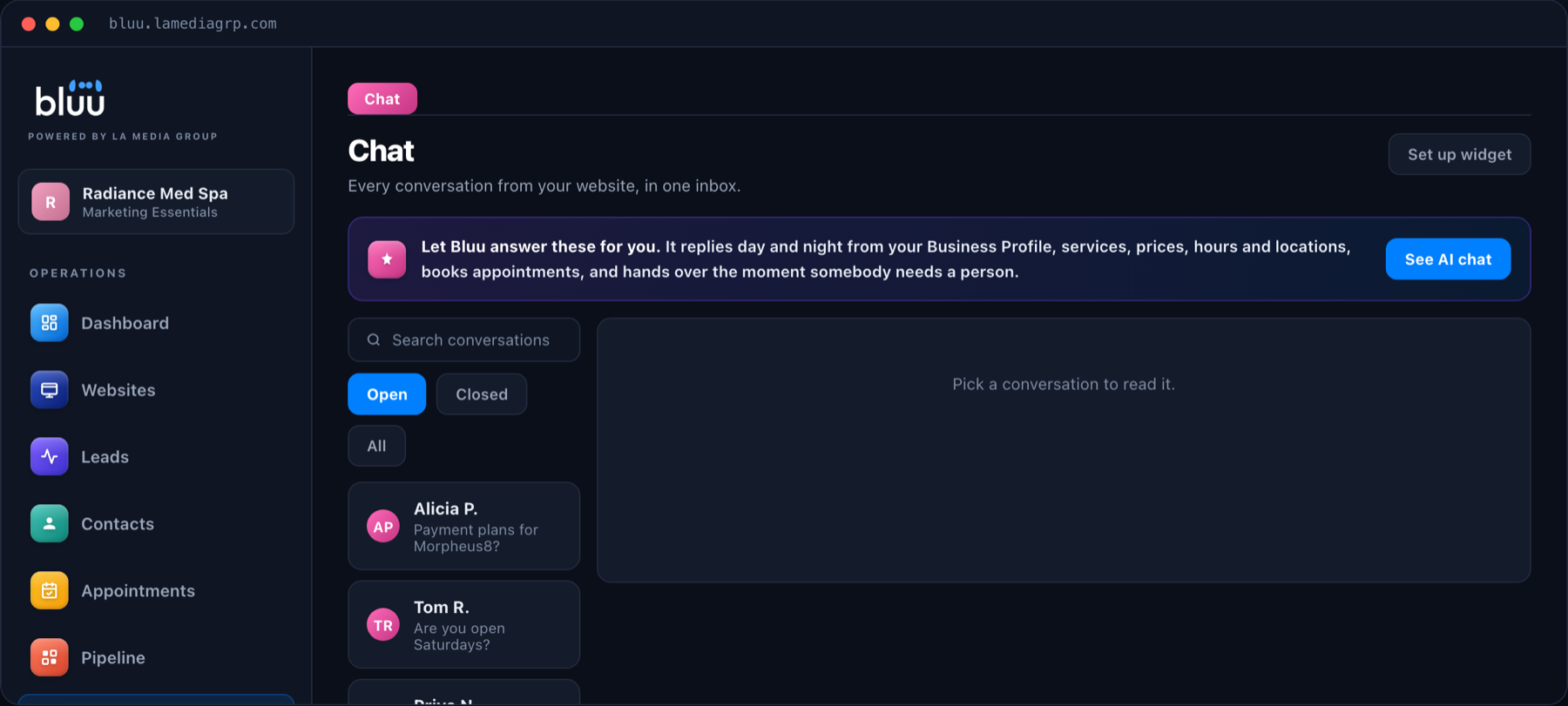
The single most valuable use of AI for a local business is answering website visitors the moment they ask. An AI chat that knows your services, hours and locations can answer common questions at 11pm, collect the visitor's name and contact details, and even book an appointment. Every one of those conversations lands in the CRM as a lead. We cover this in depth in our guide to AI chatbots for small business websites.
Filling In Records So Nobody Has To
The reason most CRMs go stale is data entry. AI can read your website to fill in your business profile, services and opening hours, and structure the details people give in forms and chats, so the CRM is complete from the start rather than relying on someone to type.
Writing the First Draft
Follow up emails, review replies, social posts and blog articles all start with a blank page. AI that writes a good first draft in your voice, which you then edit, saves a surprising amount of time each week.
Answering Your Team's Questions
An assistant inside the software that can explain how to do something, at any hour, means fewer interruptions and less time hunting for help.
Learning From What It Missed
Good AI improves on your business specifically. When it cannot answer a customer's question, the best systems record it so you can supply the right answer once and have it used from then on.

AI Features That Are Mostly Hype for Local Businesses
- Predictive lead scoring. Useful for companies with thousands of leads and years of history. A local business with a few dozen leads a month gets more from simply replying fast.
- Revenue forecasting. Accurate forecasts need large, consistent data sets most small businesses do not have.
- Fully automated selling. AI can answer, capture and book. It should not be negotiating prices or making promises on your behalf.
- AI everything. A feature labelled AI is only worth paying for if it saves time or wins customers. Ask what it does, not what it is called.
The Rules Any Customer-Facing AI Must Follow
When AI speaks to your customers, it speaks for your business. Before you switch any on, make sure it follows these rules, and that your own settings cannot override them:
- It never invents a price. If a price is not in your information, it says so and offers to have someone confirm.
- It never gives professional advice that should come from a qualified person, whether medical, legal, financial, insurance or safety.
- It never promises results your business cannot guarantee.
- It hands over to a person when it is unsure, when the customer asks, or when the topic needs a human.
- It never claims to have done something it has not, such as booking an appointment that was never made.
These are built into how the AI in Bluu works.
AI should make your business more responsive, not more risky. The rules matter as much as the features.
What a Day Looks Like With an AI-Powered CRM
It helps to picture the difference on an ordinary day.
At 9:40pm on a Sunday, someone visits your website and asks whether you offer weekend appointments. The AI chat answers from your hours, asks for their name, email and phone, and books them into Tuesday at 10am. The booking lands in your calendar, the person becomes a contact, and a confirmation and reminder go out on their own.
On Monday morning, your team opens one inbox and sees every enquiry from the weekend with its source. Two questions the AI could not answer are waiting in a short list; you type the answers once and the AI uses them from then on. Your receptionist asks the built-in assistant how to move an appointment, and gets the exact steps without waiting for anyone.
None of that needed somebody to work on Sunday night, and none of it relied on anyone remembering to copy details from one tool into another. That is what AI in a CRM should feel like: fewer missed customers and less typing, not a new dashboard full of predictions.
Your Data and AI
Ask any vendor how your customer data is used. Customer details should be stored securely, scoped to your business, and used to serve your customers, not to answer questions for somebody else's. An AI chat should also avoid carrying one customer's conversation into another's, which is why we rebuild every reply from your business information rather than from other chats.
How AI Works in Bluu
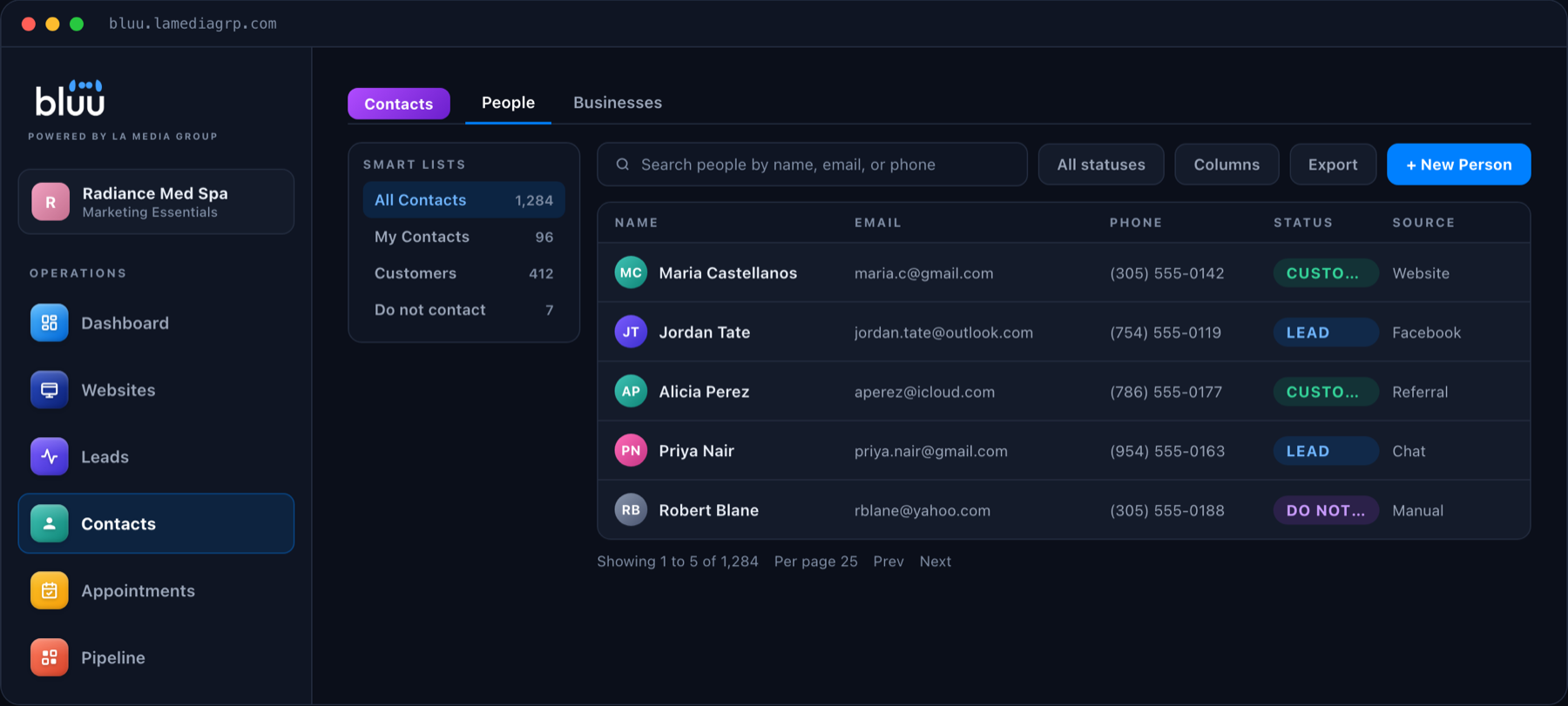
Bluu is an AI-powered CRM built for local service businesses, and its AI is focused on the jobs above:
- AI website chat answers visitors from your own business information, captures their name, email and phone, books appointments when you take them online and hands over to your team when needed. Questions it cannot answer are collected so you can teach it the right answer once.
- Website reading fills in your business profile, services and pages from your site, so the AI and the CRM start complete.
- An AI assistant inside the dashboard answers how-do-I questions for your team at any hour.
- AI writing drafts blog articles and social posts in your voice.
Everything the AI touches lands in the same Contacts CRM, next to your forms, bookings and calls. Bluu is $199 a month with a one time $199 setup, month to month, with no contracts and no charge per staff login.
Talk to a real person
See an AI-Powered CRM Working on Your Business
On a 20 minute call we will read your website into Bluu and show you the AI answering questions about your own services. Month to month, with no contracts.
A Checklist for Choosing an AI-Powered CRM
- Does the AI answer website visitors and capture their contact details?
- Does it learn from your website and business details automatically?
- Can it book appointments, and does it refuse to book times you are not available?
- Does it follow firm rules on prices and professional advice?
- Does it hand over to a person clearly, with the conversation attached?
- Can you see and fix the questions it could not answer?
- Is every conversation saved on the customer's record in the CRM?
- Is the pricing flat, or does it climb per user and per AI feature?
Frequently Asked Questions
What is an AI-powered CRM?
An AI-powered CRM is customer relationship management software that uses artificial intelligence to do work a person would otherwise do, such as answering website visitors, capturing their details, filling in records and writing first drafts.
Is AI CRM software worth it for a small business?
It is when the AI does jobs that matter, such as answering leads at any hour and removing data entry. Features built for large sales teams, like predictive scoring, usually add little for a local business.
Can an AI chatbot book appointments?
Yes. In Bluu, if you take appointments online, the AI can check your real availability and book the customer in during the conversation, and it will not book times you are unavailable.
Will the AI give my customers wrong information?
A well built AI answers only from your business information and says when it does not know. It should never invent prices or give professional advice, and it should hand over to your team when unsure.
How much does an AI-powered CRM cost?
Prices vary widely and many vendors charge extra per user or per AI feature. Bluu is $199 a month with a one time $199 setup, including website chat with AI and unlimited staff logins.
The Bottom Line
AI-powered CRM software is worth paying for when it answers your customers faster, removes data entry and gives your team time back, and when it follows firm rules about what it will and will not say. Ignore the label and judge the jobs it does.
If you would like to see it working on your own business, book a call or send us a message.