
In this article
- What the Research Says About Lead Response Time
- Where the Delays Really Come From
- How to Respond to Leads Faster
- What to Say in Your First Reply
- Track the Number That Matters
- How Bluu Shortens Your Lead Response Time
- A Simple Speed to Lead Policy You Can Use
- Common Lead Follow Up Mistakes
- Frequently Asked Questions
- The Bottom Line
When someone fills in a form on your website, they have rarely contacted only you. They have usually sent the same enquiry to two or three businesses, and the first one to reply has a head start that is very hard to overcome. That is why lead response time, how quickly you get back to a new enquiry, is one of the most important numbers in a small business, and one of the least measured.
Most owners believe they reply quickly. When we look at the actual timestamps, the picture is often different: enquiries that arrived on a Friday evening answered on Monday, form submissions that went to an inbox nobody checks, missed calls that never got a call back.
This article covers what the research says about speed to lead, where the delays really come from, and how to make sure no enquiry waits on your team again.
Key takeaways
- Research published in Harvard Business Review found firms that tried to contact a lead within an hour were nearly seven times as likely to qualify it as those that waited even an hour longer.
- The same research found many companies never responded to web enquiries at all.
- Delays usually come from enquiries scattered across inboxes, not from lazy staff.
- One inbox for every lead, instant alerts and a clear owner for each enquiry fix most of the problem.
What the Research Says About Lead Response Time
The best known study on this was published in Harvard Business Review in 2011, in an article called The Short Life of Online Sales Leads. The researchers looked at how quickly companies responded to web-generated leads, and what happened as a result.
Two findings stand out. Firms that tried to contact a potential customer within an hour of the enquiry were nearly seven times as likely to qualify the lead as those that tried even an hour later. And when the researchers audited how companies actually responded to web enquiries, a large share never responded at all.
The study looked at larger companies, but the lesson travels straight to a local business. A person who has just asked about your services is paying attention right now. An hour later, they have moved on, or booked with someone who answered.
A lead is not a name in a list. It is a person deciding, right now, who to trust with their problem.
Where the Delays Really Come From
When response times are slow, the cause is rarely that someone did not care. It is almost always the setup.
Enquiries Arrive in Too Many Places
Website forms go to one inbox, chat to another, Facebook leads to a third, voicemails to a phone, and booking requests to a calendar. Nobody can watch all of them, so something always waits.
Nobody Owns the Enquiry
When a lead arrives in a shared inbox, everyone assumes someone else has it. By the time anybody checks, a day has gone by.
Alerts Do Not Reach Anyone
Notification emails land in a folder nobody reads, or go to someone who has since left the business. The lead exists, but nobody knows about it.
After Hours Is a Black Hole
Many enquiries come in during evenings and weekends, which is exactly when nobody is watching the inbox. Without a plan for after hours, those leads wait until Monday.

How to Respond to Leads Faster
These steps make the biggest difference, in roughly this order.
- Put every lead in one place. Forms, chat, bookings, ad leads and calls, all in one inbox, newest first.
- Alert the right people instantly. By email, by text and on their phone, so a new lead is seen within minutes, not hours.
- Give every enquiry an owner. One person is responsible for the first reply. Everyone else can see it, but one person acts.
- Show how long each lead has waited. A visible timer changes behaviour faster than any policy.
- Cover after hours. An AI chat on your website can answer questions and capture details at night, and an automatic reply can tell form enquiries when to expect a call.
- Follow up more than once. If they do not answer the first call, try again later that day and the next. Many leads are won on the second or third attempt.
What to Say in Your First Reply
Speed matters more than polish, so have your first reply ready before the lead arrives. Keep it short, personal and focused on the next step.
By Phone
"Hi Jordan, it is Sam from Coastal Plumbing. You just sent us a message about your water heater, so I wanted to call straight away. Is now a good time for two quick questions?"
By Text
"Hi Jordan, thanks for reaching out to Coastal Plumbing about your water heater. I can get someone out this week. Is a call in the next 15 minutes okay, or would you rather text?"
By Email
"Thanks for getting in touch, Jordan. I have your message about the water heater. The quickest way to get you a firm price is a two minute call. What is the best number and time to reach you today?"
Each one does three things: it uses their name, it shows you read what they asked, and it asks for one small next step. Replace the names and details with your own, and keep them somewhere your whole team can use them.
Track the Number That Matters
You cannot improve what you do not measure. Check, every week, how long new leads waited before the first reply, and where they came from. You will quickly see which sources are being answered fast and which ones are being forgotten.
How Bluu Shortens Your Lead Response Time
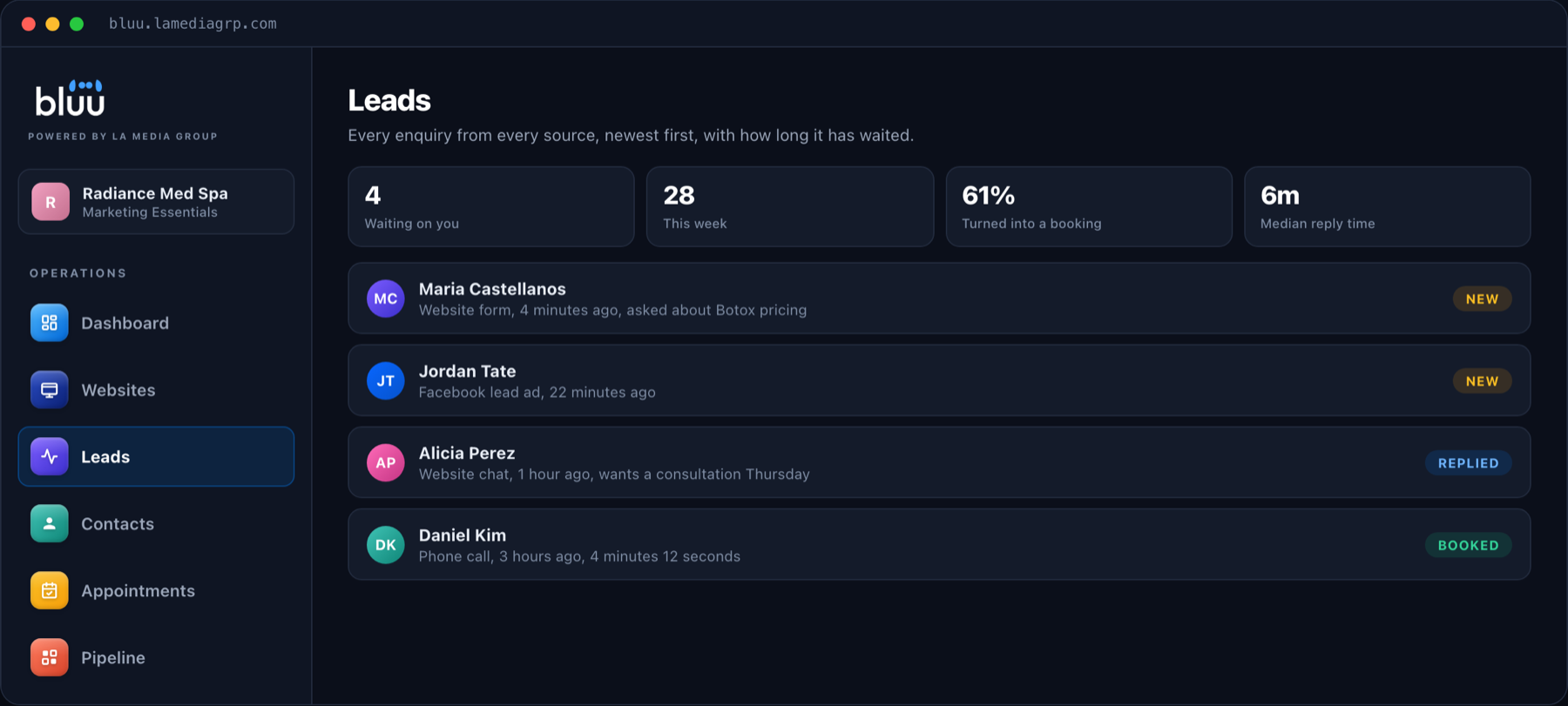
The Leads app in Bluu exists for exactly this problem. Every enquiry lands in one inbox: website form submissions, website chats, online bookings, Facebook Lead Ads, and phone calls from call tracking, with missed calls flagged so they get a call back. If you use other tools, they can send their leads in too.
Each new lead alerts your team by email and text, and Bluu can be installed on your phone's home screen so new leads arrive as phone notifications, even with the app closed. Every lead shows its source, what the person asked and how long it has been waiting, and every lead becomes a contact in your CRM automatically, so follow ups do not depend on anybody's memory.
Talk to a real person
Want to Stop Losing Leads to Slow Replies?
On a 20 minute call we will show you every enquiry from every source landing in one inbox, with alerts on your phone. Month to month, with no contracts.
A Simple Speed to Lead Policy You Can Use
Write this down and share it with your team. Adjust the times to suit your business.
- Every new lead gets a first reply within 15 minutes during business hours.
- Leads that arrive after hours get an automatic acknowledgement immediately, and a personal reply by 10am the next working day.
- Missed calls are returned within 30 minutes.
- Every lead gets at least three attempts to reach them before it is closed.
- Every Monday, review last week's response times and the leads that were never answered.
Common Lead Follow Up Mistakes
- Waiting to reply until you have the full answer. A quick "thanks, here is what happens next" beats a perfect reply tomorrow.
- Only trying once. Many people do not answer the first call.
- Treating calls as separate from leads. A missed call is a lead, and should be tracked like one.
- Letting enquiries live in personal inboxes. When that person is away, the leads stop.
- Not knowing where leads come from. If you cannot see the source, you cannot tell which marketing is working.
Frequently Asked Questions
What is lead response time?
Lead response time is how long it takes your business to reply to a new enquiry, from the moment it arrives to your first real response, whether that is a call, an email or a text.
What is a good lead response time?
As fast as you can make it. Research published in Harvard Business Review found that contacting a lead within an hour made it nearly seven times as likely to be qualified as waiting longer. For a local business, replying within minutes during business hours is a strong target.
What is speed to lead?
Speed to lead is another name for the same idea: the faster you respond to a new enquiry, the more likely you are to win the customer, because people often contact several businesses at once.
How do I respond to leads after hours?
Use an AI chat on your website to answer questions and capture details around the clock, send an automatic acknowledgement to form enquiries, and make sure someone follows up first thing the next working day.
How can I see all my leads in one place?
A lead inbox like the Leads app in Bluu collects enquiries from your website forms, chat, bookings, ad campaigns and call tracking into one list, with alerts so nobody misses a new one.
Should I call or email a new lead first?
If they gave you a phone number, call first, then follow with a short text or email so they have your details in writing. A call is the fastest way to have a real conversation, and the written follow up catches people who could not pick up.
The Bottom Line
Your lead response time decides more jobs than your prices, your website or your reviews, because the customer who hears from you first is the customer most likely to choose you. Put every lead in one place, alert the right person instantly, give every enquiry an owner and cover the hours when nobody is watching.
If you want to see how that would look for your business, book a call or send us a message.