
In this article
- The Quick Comparison
- Local Services Ads: Pay Per Lead at the Top of Google
- Google Search Ads: Full Control, Pay Per Click
- Meta Ads: Reach People Before They Search
- Local Services Ads vs Google Ads: The Key Differences
- What a Good Setup Looks Like Across All Three
- Which Is Right for Your Business?
- Common Mistakes When Choosing Between Them
- How to Split Your Budget
- Track All Three in One Place
- Frequently Asked Questions
- The Bottom Line
Most local service businesses end up asking the same question: where should our ad budget go? The three big options work very differently. Local Services Ads vs Google Ads is a choice between paying per lead and paying per click, and Meta ads on Facebook and Instagram reach people before they have started searching at all.
We run all three for local service businesses, so this comparison is about fit rather than favorites. It covers how each one is priced, where it appears, who it reaches, its strengths and weaknesses, and how most businesses should split their budget.
Key takeaways
- Local Services Ads charge per lead and appear at the very top of Google for the services they cover.
- Google Search Ads charge per click and give you full control over keywords, ads and landing pages.
- Meta ads on Facebook and Instagram reach people before they search, which suits visual services, offers and building demand.
- Most local businesses do best combining search-based ads first, then adding Meta to grow demand, with every lead tracked to its source.
The Quick Comparison
| Local Services Ads | Google Search Ads | Meta Ads | |
|---|---|---|---|
| You pay for | Each valid lead | Each click | Mostly impressions or results you choose |
| Where it shows | Top of Google search for covered services | Google search results and partner sites | Facebook and Instagram feeds, stories and reels |
| Customer intent | High, actively searching now | High, actively searching now | Lower, not searching yet |
| Control over ads | Very little | Full: keywords, copy, landing pages | Full: audience, creative, placement |
| Trust signal | Google Verified badge, reviews | Your ad and landing page | Your creative and page |
| Best for | Calls for core services | Every service, every area, full control | Visual services, offers, building demand |
How the three ad platforms compare for a local service business.
Local Services Ads: Pay Per Lead at the Top of Google
Local Services Ads appear above everything else for services Google offers them in, with your rating, reviews and the Google Verified badge. You pay for leads such as calls and messages, not clicks, and Google prices a message lead at half the cost of a phone lead.
Strengths: top placement, pay only for leads, instant trust from the badge. Weaknesses: very little control over wording or targeting, only available for certain categories and areas, and your ranking depends heavily on reviews and how quickly you respond.
Our Local Services Ads guide covers how they work in detail.
Google Search Ads: Full Control, Pay Per Click
Search ads appear when someone searches the keywords you choose, in the areas you choose, with the ad and landing page you write. You pay when someone clicks.
Strengths: full control over keywords, messaging, landing pages, schedules and areas; works for every service you offer; reaches people the moment they search. Weaknesses: you pay for clicks whether or not they call, it needs expert setup and ongoing management, and costs vary widely by industry and city.

Meta Ads: Reach People Before They Search
Facebook and Instagram ads reach people based on who they are and where they live, not what they are searching for. That makes them less about catching urgent demand and more about creating it.
Strengths: strong visuals and video, precise local targeting, good for offers, seasonal promotions, events and services people do not search for until they see them, and lead forms that collect details without leaving the app. Weaknesses: lower intent than search, lead quality varies, and creative needs refreshing often.
Local Services Ads vs Google Ads: The Key Differences
Because both appear on the same Google results page, these two are the ones most often confused. The differences come down to four things:
- How you pay. Local Services Ads charge per lead. Google Search Ads charge per click, whether or not that click becomes a call.
- How much you control. With Local Services Ads, Google writes the ad from your profile and decides who sees it. With Search Ads you choose the keywords, the wording, the landing page, the areas and the schedule.
- What drives your position. Local Services Ads lean heavily on reviews, verification and responsiveness. Search Ads lean on your bid, your ad's relevance and the quality of your landing page.
- What they cover. Local Services Ads only exist for certain categories and areas. Search Ads can advertise any service you offer, anywhere you work.
In practice, most service businesses run both: Local Services Ads for the steady stream of calls at the top of the page, and Search Ads for full control, every service and every area.
What a Good Setup Looks Like Across All Three
- Search first. Local Services Ads and Google Search Ads for your most profitable, most searched services.
- Separate campaigns by service and area, so you can see which combinations produce customers.
- Landing pages that match each ad, with a phone number, a booking button and real reviews.
- Meta ads for demand, promoting offers, seasonal services and before-and-after results to people near you.
- Retargeting, reminding people who visited your site but did not get in touch.
- One place for every lead, with its source, so the comparison is fair.
Which Is Right for Your Business?
- Emergency and urgent services(plumbing, HVAC repair, locksmiths, towing): start with Local Services Ads and Google Search Ads. People need you now.
- Planned, considered services(remodeling, roofing replacement, legal, financial): Google Search Ads plus Local Services Ads, with Meta for retargeting and reviews.
- Visual and lifestyle services(salons, med spas, fitness, landscaping design): Meta ads earn their place alongside search, because the results sell themselves in a photo.
- New businesses with few reviews: Google Search Ads first. Local Services Ads favor businesses with strong reviews and fast response times.
The best ad platform is the one that produces customers at a cost you can live with. You only know which that is if every lead is tracked to its source.
Common Mistakes When Choosing Between Them
- Picking one and ignoring the others. Each platform catches customers at a different moment, and most businesses grow fastest with a mix.
- Judging on cost per click. A cheap click that never calls is expensive. Compare cost per customer.
- Sending ad traffic to the homepage. Every campaign deserves a page about that service.
- Running Meta ads for emergency services. People with an urgent problem search, they do not scroll.
- Not tracking calls. Calls are usually the most valuable lead, and without tracking the platform producing them looks worse than it is.
How to Split Your Budget
There is no universal split, but this approach works for most local service businesses:
- Start with search-based ads(Local Services Ads and Google Search) for your most profitable services.
- Track every lead, calls included, back to the platform and campaign that produced it.
- After a month or two, compare platforms on cost per customer, not cost per click or cost per lead.
- Add Meta ads to grow demand, promote offers and retarget visitors once search is working.
- Move budget monthly toward whatever produces customers most cheaply.
Track All Three in One Place
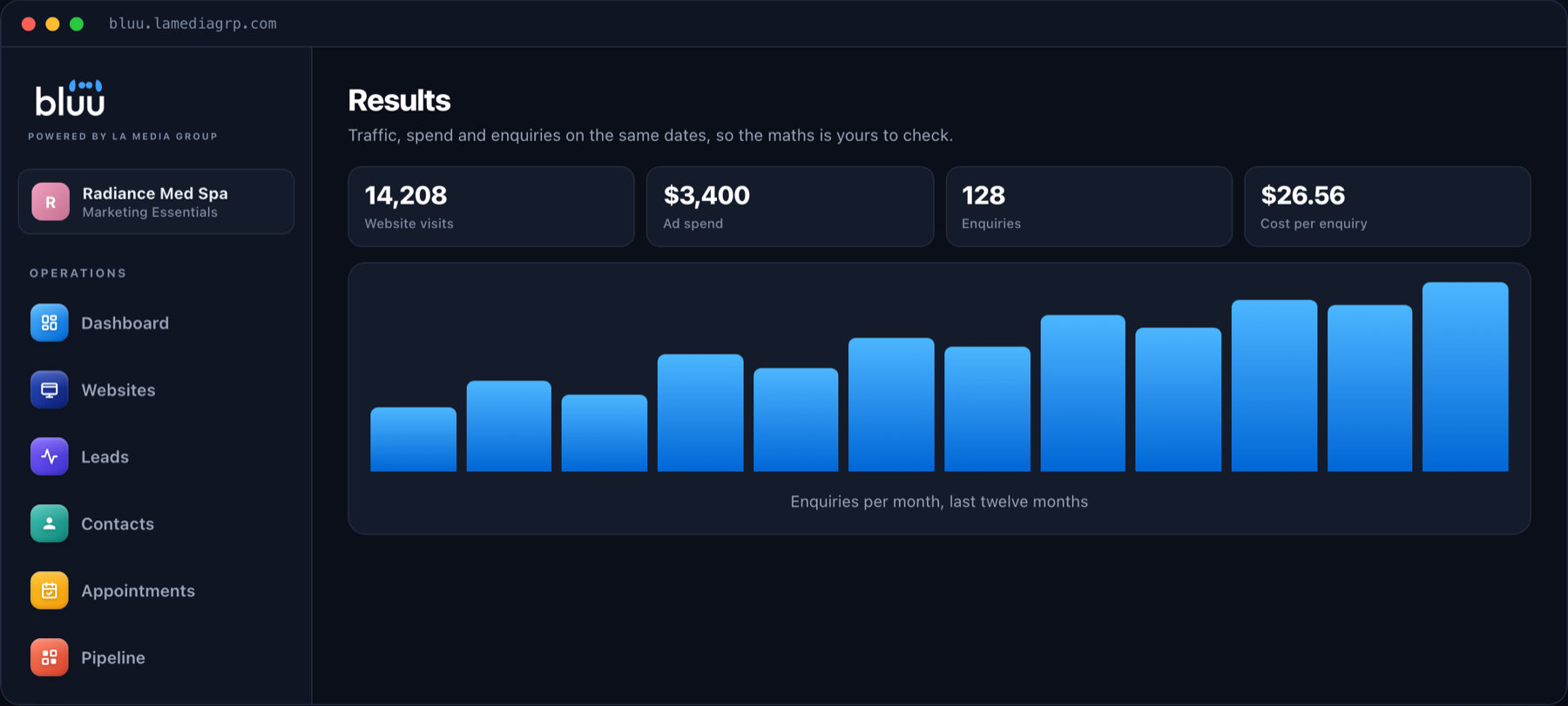
Comparing platforms only works if their leads end up in the same place. Local Services Ads report in their own dashboard, Google Ads in another and Meta in a third, and none of them knows which leads became customers.
In Bluu, Google Ads and Facebook ads spend and results sit on one Analytics screen, and leads from Facebook Lead Ads, website forms, chat, bookings and tracked calls land in one Leads inbox with their source. Local Services Ads leads can be logged alongside them, so every platform is judged on the same numbers. Read our marketing lead tracking guide for the full setup.
Talk to a real person
Not Sure Where Your Ad Budget Should Go?
On a 20 minute call we will look at your business and your current ads, and tell you honestly which platforms we would use first. Month to month, with no contracts.
Frequently Asked Questions
What is the difference between Local Services Ads and Google Ads?
Local Services Ads charge per lead, appear at the very top of Google for covered services and offer little control over wording. Google Search Ads charge per click and give you full control over keywords, ads, landing pages and targeting.
Are Facebook ads good for local service businesses?
Yes, for the right services. Facebook and Instagram ads work well for visual services, offers, events and building demand. For urgent needs, search-based ads usually perform better.
Which is cheaper, Local Services Ads or Google Ads?
It depends on your industry, area and how well your account is run. Compare them on cost per customer rather than cost per click or per lead, because a cheaper lead that rarely buys is not cheaper.
Can I run Local Services Ads and Google Ads together?
Yes, and most service businesses should. They appear in different places on the same results page and complement each other.
How do I know which ads are working?
Track every lead, including phone calls, back to the platform and campaign that produced it, then record which leads became customers and what they were worth.
Should a new business start with Local Services Ads?
Usually not first. Local Services Ads favor businesses with strong reviews and quick response times, so a new business often starts with Google Search Ads while it builds reviews, then adds Local Services Ads.
Do Meta ads work for emergency services?
Rarely as the main channel. People with an urgent problem search rather than scroll. Meta ads are better for planned services, offers and staying in front of people who have already visited your website.
How much should I spend on each platform?
Start where intent is highest, usually Local Services Ads and Google Search Ads, then move budget monthly toward whichever platform produces customers at the lowest cost.
What results should I expect in the first month?
Expect learning rather than final numbers. The first month shows which services, areas and ads produce calls, and most campaigns improve once that data is used to adjust budgets and targeting.
The Bottom Line
Local Services Ads, Google Search Ads and Meta ads each do a different job. Search-based ads catch people who need you now; Meta ads build demand before people search. Start with search, track every lead to its source, and move your budget toward whatever produces customers most cheaply.
If you would like help deciding, book a call or send us a message.